
Back pain
The most common reason people first come in.
Learn moreWhat we do
Chiropractic care for horses and dogs, working alongside your veterinarian. Assessment happens where your animal lives and works.
🐴 Horses and dogs
🤝 Alongside your veterinarian
📍 Serving Ocala area
The short answer
Animal chiropractic is hands-on care for a horse or dog's spine and joints, given by a chiropractor with additional certification in animal work. It looks at how the animal moves, finds joints that are not moving well, and adjusts those specifically. It works alongside your veterinarian rather than in place of them, and it is not a diagnosis or a treatment for disease.
Most owners come to this because something changed and nobody can quite say why. A horse is short on one rein, or unwilling to pick up a lead it used to take, or hollow through the back under saddle. A dog stops jumping onto the sofa. Nothing looks broken, the vet has ruled out the obvious, and the animal is simply not moving the way it used to.
A horse carries a rider, a saddle and its own considerable weight through movement that asks a great deal of the spine and pelvis. When one area stops moving freely, the rest of the body works around it, and that shows up as behaviour long before it shows up as lameness.
The things owners notice first are usually small and easy to explain away.
None of those are proof of anything on their own. They are the reason to have the horse looked at, by a vet first where there is any question of pain or lameness, and then by someone who assesses how it moves.
The same principle applies at a smaller scale. A dog that has stopped taking the stairs, hesitates before jumping into the car, sits with one leg out to the side, or has slowed down on walks is telling you something about how it is moving. Working dogs and sporting dogs ask a lot of their spines, and so do older dogs carrying stiffness they have learned to live with.
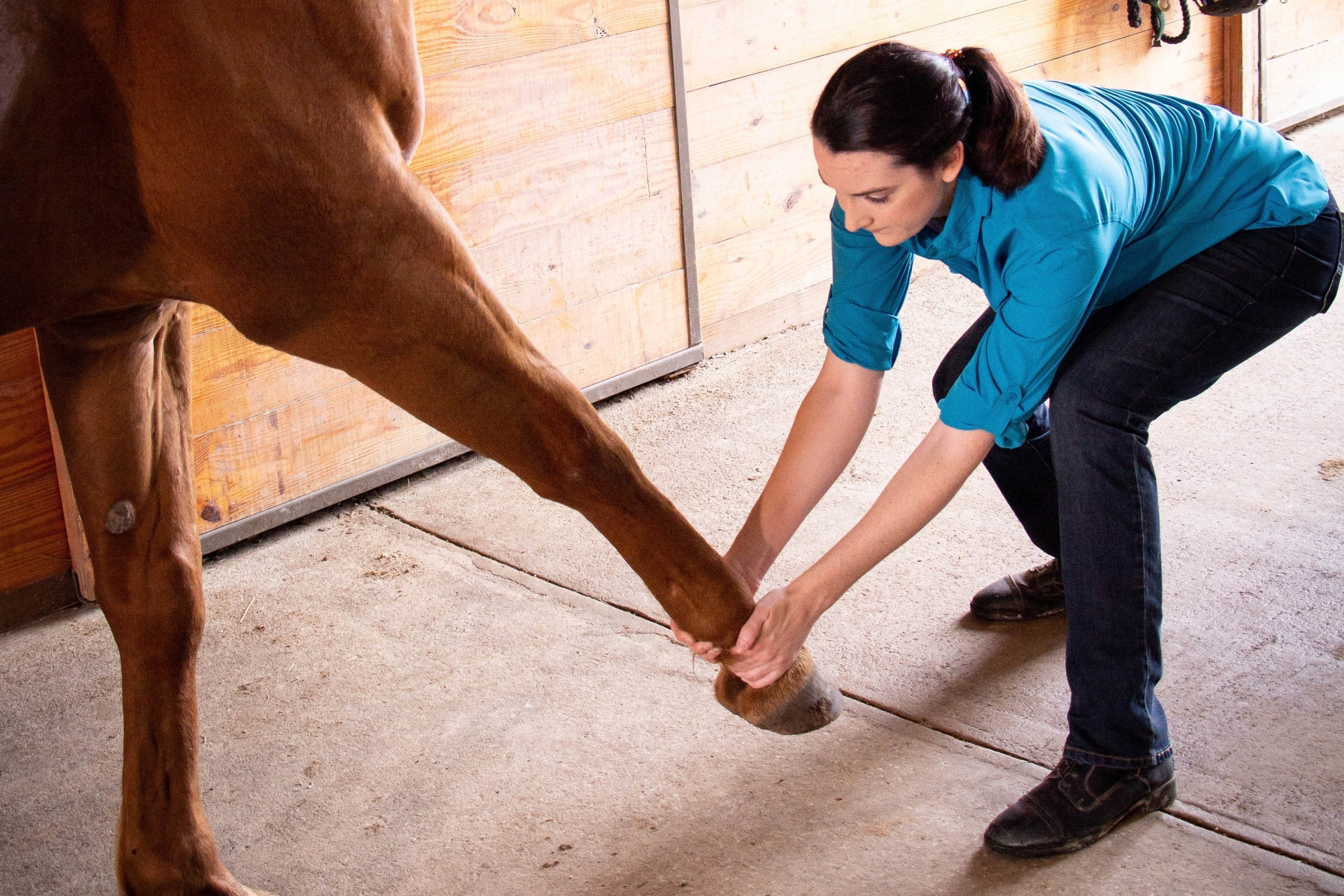
The first visit is mostly watching and asking. What changed, when, and what makes it better or worse. Then the animal is watched moving, and worked through by hand, joint by joint, to find what is not moving as it should.
Adjustments on an animal are quick and specific. There is no sedation and no equipment. Most animals stand quietly for it, and many will tell you plainly which spot was the problem. Assessment happens at your barn or your home, because a horse moves like itself on ground it knows, and because tack, footing and routine are part of the picture and cannot be seen from anywhere else.
This is care that sits alongside veterinary medicine, not care that replaces it. Lameness, pain and a change in behaviour can have causes that need a veterinary diagnosis, and some of them are serious. If something found here belongs with your vet, you will be told plainly and it will go to your vet. Nothing here is a substitute for that.
An animal in acute distress, an animal with an undiagnosed lameness that has not been seen by a vet, or a suspected fracture or infection needs veterinary attention first. Chiropractic care is for how an animal moves. It does not treat disease, and an honest answer is worth more than a booked appointment.
Tell us what you have noticed and we will tell you honestly whether this is the right kind of care for it.
Book your first visitBoth. Horses are the larger part of the work, and both are assessed the same way: by watching how the animal moves and then working through the spine and limbs by hand.
Tell us who your veterinarian is when you book and we will fit around them. Animal chiropractic works with veterinary medicine, so we would rather be in touch with your vet than around them, and anything that belongs with them goes to them.
At your barn or your home. A horse is assessed moving, and it moves like itself on ground it knows, so going to it gives a better answer than asking it to travel.
An adjustment is quick and specific rather than forceful. There is no sedation and no equipment. Most animals stand quietly, and it is common for one to relax noticeably once the sore spot has been worked on.
That depends on what is found and how long it has been going on, and you will get a straight answer after the first visit rather than a package before it. If this is not the right kind of care for your animal's problem, we will say so.